


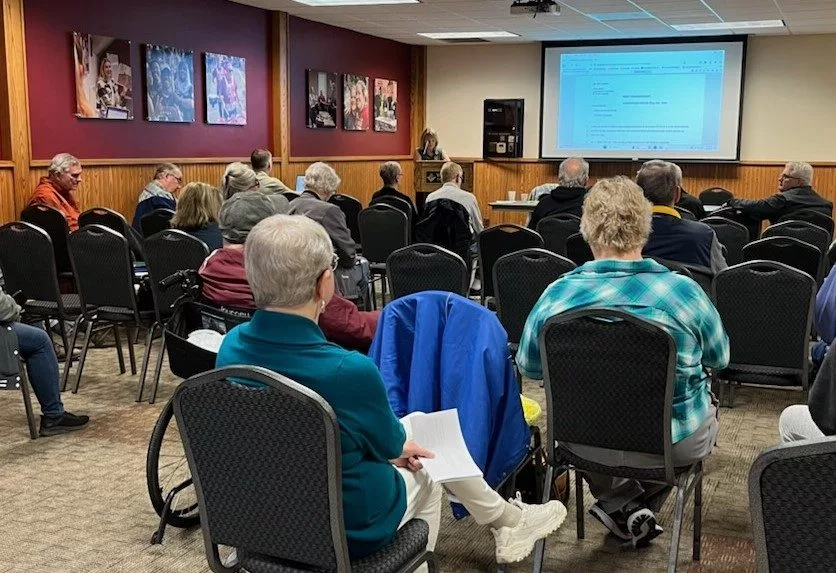
VALLEY CITY, N.D. (NewsDakota.com) – The fourth Legislative Forum sponsored by the local League of Women Voters (LWV) and the Valley City-Barnes County Development Corporation was held at the VCSU Skoal Room with just over 30 people, but no legislators, present.
A large part of the discussion focused on HB 1540 which would allocate public money to support private schooling. About 10 people expressed opposition to giving state money to students for the purpose of attending private school. They stressed the possible illegality of giving state money to support religious schools (according to Section 8 of the ND Constitution), the harm that would be done to the public school system, and the high cost to the state’s overall budget. They disagreed with the one proponent who argued that giving the money to private schools would cause competition for students which would result in public schools trying harder to do a good job. He was reminded that, based on a national comparison of schools, the public schools in ND, while clearly underfunded, are doing quite a good job.
There was brief discussion on charter schools, which are a private-public partnership but are not available to most rural students, and in other states many have not stayed in business more than a few years.
Discussion on property tax relief centered on HB 1176 and HB 1534. There is uncertainty about what will come out of those bills, which deal with whether to include agricultural property for tax credits along with residential property, and limiting the percentage of property valuation which would be taxable.
The question of term limits for legislators was briefly discussed. Some people oppose term limits, but others reminded the audience that voters approved specific limits in a previous election; the current legislature is looking at methods of modifying or rescinding the people’s vote.
Heated discussion ensued on SB 2307, which would allow criminal prosecution of library professionals in order to mandate that libraries sequester sexually explicit material into a restricted section. Instead of answering to their board, librarians would be required to answer to the attorney general and local state’s attorneys. It was noted that this bill would substitute state mandates for the judgment of parents, educators, and locally elected officials who now govern their libraries and schools. Interest was high regarding the question of how much responsibility parents should take in restricting what their children check out from libraries. As of this writing, the version of SB 2307 that appears on the ND Legislature’s website lists a cost to taxpayers of $1,110,837.
Also related to libraries, Anita Tulp, head librarian of the Valley City Barnes County Public Library, stated that our library will see a decrease in funds coming from the Federal government due to recent cuts.
It was noted that HB 1318 would limit the liability of pesticide manufacturers for any harm caused by their products even if not listed on the label. It was stated that these labels are often determined by industry data and the EPA cannot always assure accuracy. Also, possible harms such as birth defects and cancer usually don’t manifest for years, so the right to sue manufacturers should be preserved.
Jennifer Feist of the Development Corporation moderated the discussion. Angie Martin, LWV member, welcomed everyone and reminded the audience that while LWV is non-partisan, it strongly defends voting rights and so actively opposes both gerrymandering, and the electoral college system of electing the President.
Local LWV volunteers also pointed out the League’s vigorous opposition to far-reaching voting-rights legislation currently being considered at the federal level. The so-called “SAVE” Act was passed on April 10 in the U.S. House of Representatives and now moves on to the Senate. The position of the LWV states that this proposal “will create new barriers to voter registration by requiring submission of documentary proof of citizenship materials in person every time a voter updates their registration, which particularly harms rural voters, voters of color, married women who have changed their last names, and other voters who have been historically marginalized who already face obstacles in accessing the ballot box.