


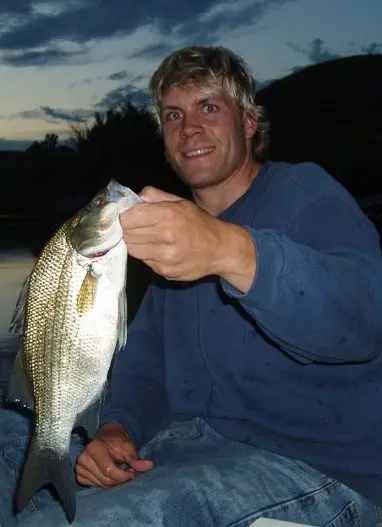
In the evenings of late summer on waters where white bass are present, they will frequently be seen schooling near the surface, providing excitement on nearly every cast. Simonson Photo.
By Nick Simonson
The slashing surface swirls of a school of white bass are tough to miss in the summer on any lake where a population of these fish are present. Equally tough to miss are the jarring strikes these panfish deliver when they’re on a baitfish bender. Connecting with white bass, or “silvers” as they’re sometimes referred to, can make some of the season’s most golden memories of hundred-fish days when schools are encountered. It doesn’t take much to catch these aggressive summer panfish and on waters from Devils Lake to Lake Ashtabula, the simplest tackle works. What follows are some tips for presentation and lures to connect with fast action.
Cast Beyond
Once a school of silvers is identified, get an idea where the edges of the group are. When casting an offering, make sure that it goes out beyond that circle so that it can be reeled into where the fish are feeding. Dropping a bait into the school can spook fish, especially if lures are a bit bigger or heavier. Cast out and bring it back to them and expect a strike as soon as the lure enters the area where swirls are occurring on the surface of the water.
Something Small
For light tackle action, a simple crappie tube on a jig will do the trick and matches the hatch of mid-summer baitfish perfectly in its one-to-two-inch profile. Utilize patterns in silver flake, salt-and-pepper and pearl to mimic the shiny, light-colored patterning of small minnows that white bass will often feed on along weedlines and other natural barriers. Insert jigheads and ball head jigs are inexpensive options to dress up and present small tubes. On an ultralight rod with four-pound-test line, white bass will provide charging runs and tons of summertime excitement that tests the drag management skills of any angler.
Going Up
From there, larger offerings like curly-tail grubs rigged on ballhead jigs on standard tackle are a great go-to for consistent action. Cast the lure beyond the area where fish are seen schooling and drag it back through the middle of the feeding frenzy, jigging the offering erratically to trigger a bite from trailing fish. To get more distance when casting and avoid spooking a group of fish, use a heavier jig head, like a 1/8 or 3/16-ounce model.
Be a Jerk
Small stick baits like the Rapala Husky Jerk, Countdown or Original Floating Minnow in sizes of two-to-four-inches are perfect offerings for aggressive white bass, and the shorter, two-hook models are fairly easy to work free from a fish when the offering gets slammed on the retrieve. Remember to work in a slight pause in the cadence to trigger any fish that are following the lure back to the boat or shore and tie an open-loop connector knot or use a quick-change snap to allow the bait to move more freely and produce better action.
Some Shine
Little spinnerbaits such as the Beetle Spin and added spinner blades on a wire arm can help attract the attention of feeding white bass. The flicker and flash of a small Colorado blade tacked on to any small jig and plastic combo will provide a bigger profile, add the shimmer of a make-believe minnow, and provide a pulsating thump to light up the lateral lines of schooling silvers. Adjust the bend in any spinnerbait arm to move the blade closer to or farther away from the hook point to ensure better connections when fish hit.
Hair and There
Finally, hair jigs and flies, such as those made with bucktail, are a great all-around offering for white bass. From shad darts to Clouser minnows, the sleek profile and subtle undulation of bucktail in the water, with perhaps a few added strands of pearl or silver krystal flash, create a powerful combination for corralling white bass. Strip and jig these offerings anywhere fish are schooling, and experiment with a variety of colors that match the local forage and provide something a bit wilder.
It is quick and inexpensive to fill a small tackle box with the baits that will work on white bass, making for easy summer memories once a school is encountered. Keep these six tips for presentation and offerings in mind to get a solid start on silvers, and experiment to find the sizes, colors and patterns that work best on any nearby white bass waters.