


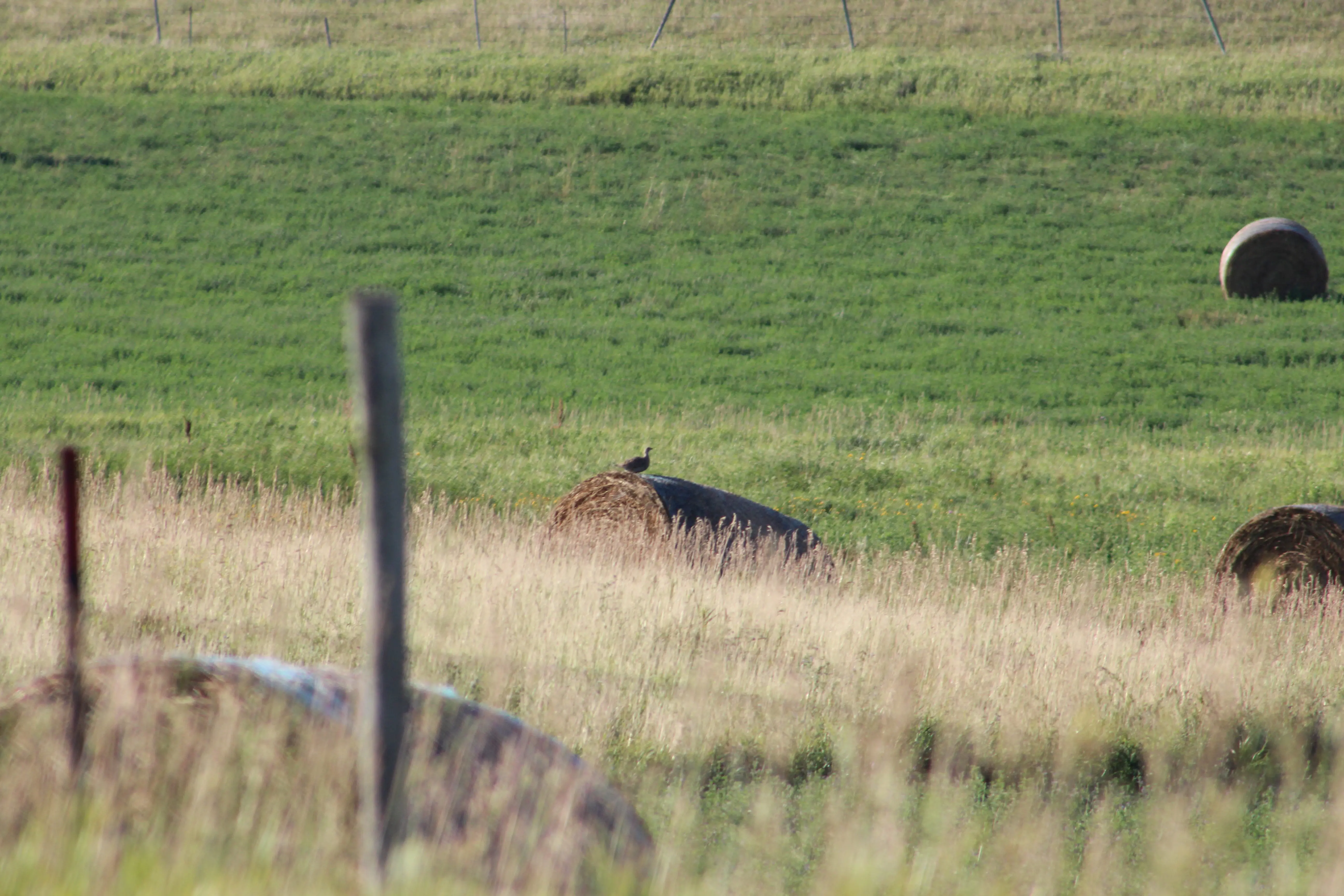
Areas where prairie grass meet alfalfa fields with some late-season regrowth are a consistent draw for sharptailed grouse in early fall. Simonson Photo.
By Nick Simonson
A cooler wet period coinciding with the sharptailed grouse nesting and brood-rearing phases in North Dakota likely hampered the recruitment of chicks into the native upland birds’ populations this spring and summer, resulting in a dip that hunters may notice when the season kicks off on Sat. Sep. 13, according to Jesse Kolar, Upland Game Management Supervisor for the North Dakota Game & Fish Department (NDG&F).
“Grouse are continuing to do okay. But the reproduction this year was pretty poor, hampered by some of the moisture we got all summer long, but the numbers remain average for the state. We saw declines in almost every district in our routes this summer, but we still see grouse along most of the areas where people are used to finding them,” Kolar details, adding, “that cold wet early-May season – sharptails start nesting right away in May – kind of impacted their ability to have a good reproduction year.”
While it may take some extra walking to get groups of the distinctive birds – known for their gurgling laugh-like clucking when startled – to flush, pockets of better numbers likely exist in areas where rains were less intense in May and June and in those regions of the state that didn’t receive as much severe weather throughout the summer. In the early season, hunters should focus on those expansive areas prairie grass adjacent to agricultural fields that held or still hold favorite food items for grouse, Kolar explains.
“Usually they’re roosting out in grassland flats so they’ll be out in areas that are pretty boring-looking to most people; knee-high or shorter grass and it’ll be relatively flat. They do like somewhat of a hillside to roost on, places where they can see in the morning,” Kolar details of where hunters can locate grouse at the start of the day, “[then] they’re going to launch off and look for a food source, whether that’s going toward a field with alfalfa, grasshoppers, sunflowers or other small grains,” he adds.
Best bets for more consistent encounters with sharptailed grouse this fall will come throughout the western portion of the state and in a few pockets in the east where habitat and anecdotal observations of localized populations are higher.
Additionally, Kolar points hunters to that newly reopened area in northeastern North Dakota where grouse share a habitat with a remaining population of prairie chickens in Grand Forks County. Being able to distinguish the two species in flight is key in preventing any accidental killing of the greater prairie chicken, which is not open to hunting in the state due to its limited populations.
“The western third of the state’s been the last area to get converted to row crop agriculture so some of those areas that still have remaining pastures are the best areas for sharptailed grouse reproduction,” Kolar explains, “in Grand Forks County we reopened an area for hunting up there last year. That area had a lot of management efforts. It has a wildlife refuge, some waterfowl production areas, a state wildlife management area as well as some university property, so there’s a lot of grasslands remaining there suitable for sharptailed grouse,” he continues.
The sharptailed grouse season opens on Sat. Sep. 13 and runs until Sun. Jan. 4, 2026. Hunting hours are one half hour before sunrise until sunset each day. The daily limit is three grouse, and the possession limit is 12. An area including the Sheyenne National Grasslands in southeastern North Dakota remains closed to sharptailed grouse hunting as the birds share the habitat there with a separate limited population of prairie chickens.
Simonson is the lead writer and editor of Dakota Edge Outdoors.