


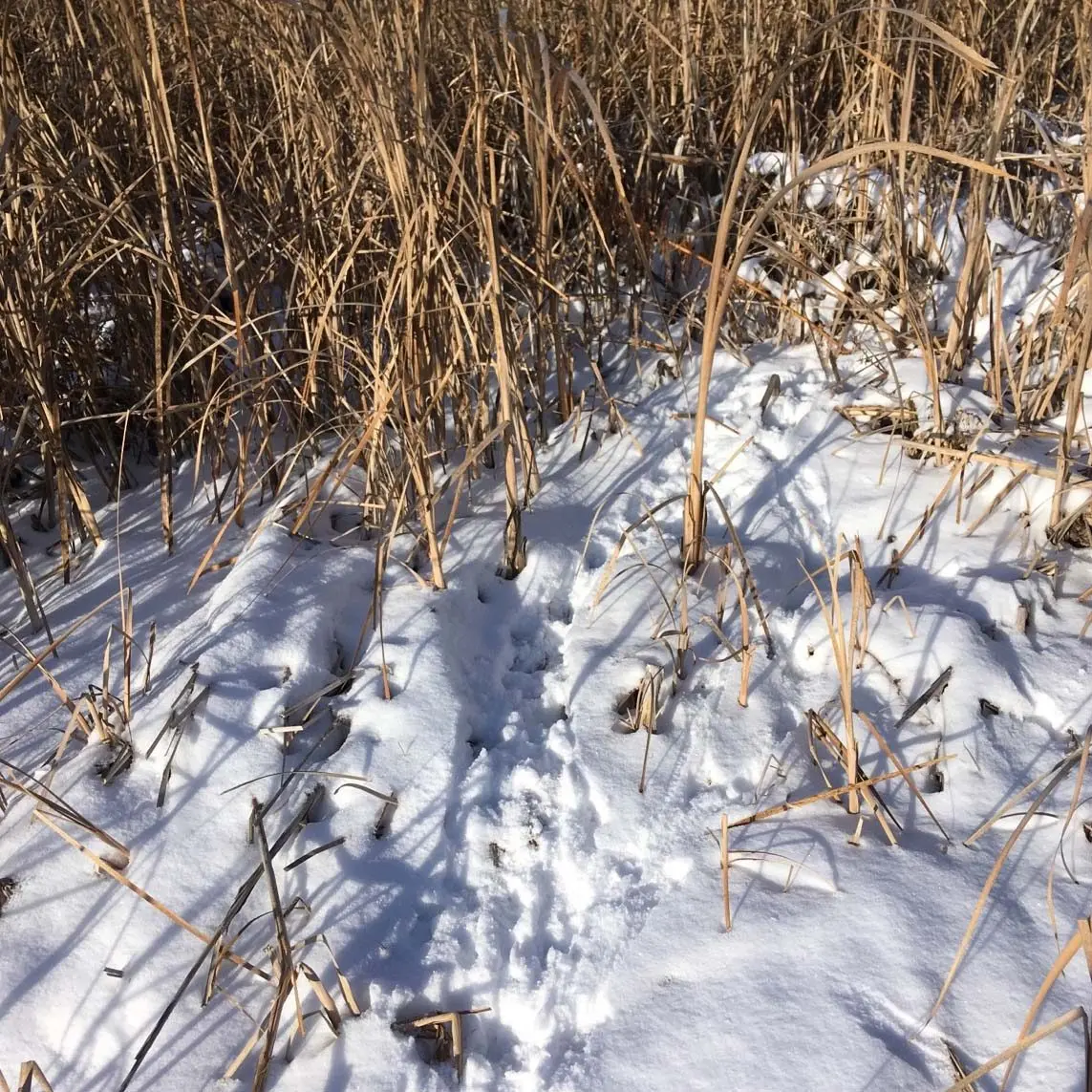
Information Superhighway. The fresh tracks in the snow from recent pheasant movement suggest a good population of birds utilizing cover, and some great hunting ahead. Simonson Photo
By Nick Simonson
Few signs are more welcome in the late season uplands than a stretch of pheasant tracks along a snow-rimmed piece of birdy habitat. Be it a slough, a stretch of brush, or a bushy shelterbelt planting of olive caraganas or crimson dogwoods, anywhere those four-toed imprints weave and wind their way from the outset of the hunt to the spot where a bird gets up under the steady point of a good dog is an enjoyable indicator that one is in the right spot, and birds were, are, or are going to be in the near future for the outing.
Even those old tracks tend to get my adrenaline going, the ones that are solidified in the icy crust of a recent melt, held tight against the elements until the next sunny day erodes their presence just a bit. To a late season hunter like me, I imagine they evoke the excitement experienced upon the discovery of the footprint of an ancient hominid to an archaeologist searching for those missing links in our ancestry, or the massive mark of a t-rex’s travels in some Jurassic mud flat from eons ago unearthed by a paleontologist. While certainly the recency of even those older frozen tracks is more modern in our blink-of-the-eye late season which comes each December and leaves at the turn of the calendar, it’s those fresher tracks that truly get my blood pumping.
A spray of snow around a pheasant’s footprint signifies a recent runner tucking and winding its way along a cattail slough, and when that track joins another, and another, and another forming a superhighway speeding through the cover, it’s then that things truly get interesting in late season. Following those markers until they can be trailed no more – whether they end in a rising rooster, a heart-attack inducing hen, or even that a-little-too-late mark in the snow at the edge of the reeds, showing a pair of wings hitting the drift on take-off – is the name of the game when searching for late season birds.
In conjunction with those tracks, especially the fresh ones, comes the trail a good bird dog follows through the snowy landscape. I imagine the scent stays tucked in each pointy toe mark, leaving just enough of an odor to connect my lab to his quarry somewhere ten, twenty or a hundred yards ahead of us. Sometimes it ends with a bird bunkered in the lean-to structure created by the bent over blades of the season’s brown cattails covered in snow, other times it makes it all the way to the other side of the deep cover where, on rare occasions, a rooster holds until we get close enough to set up a makeable shot. Like the variance in quantity of tracks and their recency, the end of the trail also is inconsistent, but always a learning experience, which is most often enjoyed when things do go our way, or when a bird surprises us with a flush from behind or from a point we didn’t expect.
However it ends, and wherever the bird gets up in both time and distance, at this time of year a line of pheasant tracks in the snow is a welcome gift on any late-season hunt. May one become many, and many lead to good points, flushes and shots that add some color to the memories that come with your favorite snow-covered hunting grounds this late season…in our outdoors.
Simonson is the lead writer and editor of Dakota Edge Outdoors.