


By Nick Simonson; “The sweat was a welcome start to my run around the edges of Waikoloa village, a resort area on the Big Island of Hawaii with a blend of development complete with condos and hotels and the obligatory golf course, along with streams and tidepools and ancient Hawaiian rock walls and pathways preserved when the facility was built. It was a nice
balance that kept wildlife front and center for those of us up early, or watching the colorful bushes and palm tress planted around the space for birds of all stripes from the zebra dove which wasn’t far off in size and call from the mourning doves back home, to the bright yellow-and-red saffron finch that lined the edges of the trimmed grass picking away for their breakfast. As I rounded the turn out of the resort just ahead of sunrise, I caught eye of a tourist in a Gilligan-style bucket hat leaning in to a pair of larger birds, edging ever closer to the striped parents bobbing their necks warily over the three grayish black chicks scuttling about their legs, and generally getting more defensive of their young. The long necks reminded me of the Canada geese back home – and all my unwanted, accidental encounters with those pairs protecting their nests and young in the spring – and the tourist reminded me of all those cell-phone armed visitors on the mainland trying to film
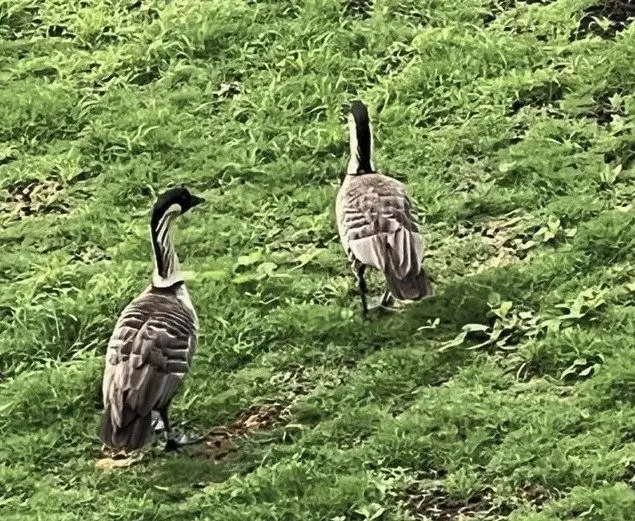
sharks in the shallows off the Washington coast (and losing their hands in the process), or get up close and personal with a bison in Yellowstone (and suddenly learning how to fly). The geese were Nene, and they were only slightly smaller than Canada geese, but they seemed just as antsy to keep their young away from the man and his camera-on-a-stick, as he laughed and laughed with each step he took towards them. While it’s believed that nene evolved from a common ancestor with modern Canada geese that arrived in the Hawaiian islands half a million years ago, these birds are now far less
plentiful than their stateside sister species, with less than 4,000 individuals alive today, making it the rarest goose in the world. As is the typical story, following Captain Cook’s arrival on the islands in the late 1700s, hunting and introduced predator species, such as mongooses, pigs and feral cats reduced the population to just 30 nene in the 1950s. Like the Canada goose, the nene’s comeback has been notable, with populations restored in 2004 to 800 birds in the wild, and around 1000 in captivity or semi-captive on the island. I didn’t stick around to see what the nene did to their morning paparazzo, and I hoped that the interaction ended with a thoughtful distance between photographer and subjects as I kept down the jogging path taking in the morning sights of varied wildlife and the warmth the islands offered while a blizzard raged back home. Along the way, pairs of nene were scattered along the golf course’s edge, and I gave them their space,
sliding to one side or the other of the small path that cut its way through their habitat, remembering I was a guest of these birds in the midst of their nesting and rearing season a world away, but having that all too familiar feeling they were much like their cousins I knew closer to home in our outdoors.”
Nick Simonson is the lead writer and editor of Dakota Edge Outdoors.
Featured Photo: Safe Distance Away. The nene, or Hawaiian goose, is the rarest goose species in the world by population. Simonson Photo.