


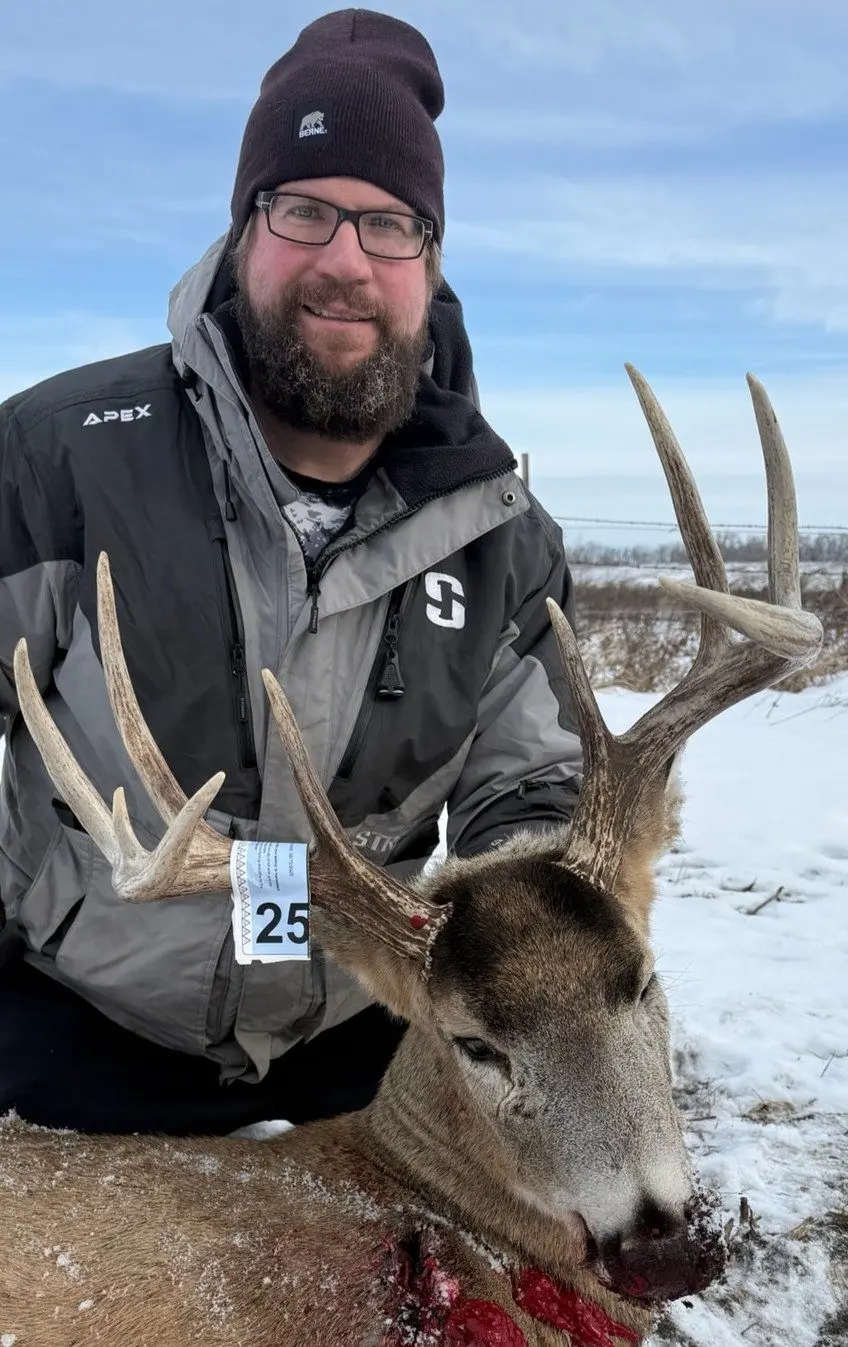
Beast of the East. Hunters found tagging a whitetail deer challenging once again in eastern North Dakota, as habitat continues to disappear from the landscape. DEO Photo by Ben Simonson.
By Nick Simonson
Habitat remained the stumbling block for North Dakota’s deer herds and hunter success in 2025 as a mild winter, and favorable spring and summer conditions could not overcome the lack of fawning areas and cover for the state’s whitetail and mule deer herds. Both species’ unique needs remain unmet in a meaningful way to help spur a recovery from the general decline in numbers observed in the Peace Garden State over the past 15 years. And more recently, severe outbreaks of epizootic hemorrhagic disease (EHD) and a harsh winter in 2022-23 have hampered an upswing dropping populations and tag numbers in 2025, according to Bruce Stillings, Big Game Management Supervisor for the North Dakota Game & Fish Department (NDG&F).
“A lot of people remember in the early 2000s we had over 3 million acres of CRP grass, this was phenomenal fawning habitat, and then we were blessed that mother nature took pity on us from 98-99 through 2007, we had really mild winter conditions,” Stillings recounts, “then three consecutive really severe winters and then at the same time those CRP contracts were starting to expire, we were starting to lose that high-quality fawning habitat,” he concludes of the recent history of the herds’ decline.
Eastern Whitetail Woes
Nowhere is the decline in whitetail deer numbers in North Dakota more evident than in the eastern third of the state, where loss of conservation reserve program (CRP) acres, comprised mostly of grass which aids in hiding young deer after birth in spring, has most impacted fawning and recruitment in the state. Additionally, with the burning, removal and drain-tiling of cattail sloughs and swampy areas in favor of expanded row cropping into these spaces, deer have lost significant bedding and thermal cover to help them survive the rest of the year.
“Now I believe it’s somewhere around 500,000 acres [of CRP] within the state, so whitetail deer numbers have really trended downward since 2011 in response to these habitat changes. We saw some slight bumps in 2018 and 2019, but overall, the trend has been certainly down, so that habitat component especially with whitetail deer in the state is a really big concern. We’re starting to see in the eastern part of the state where we’re losing quality deer habitat, we’re starting to see whitetail deer range constrict back to the major river drainages that have that habitat component,” Stillings explains.
The resulting concentration of deer in areas of habitat surrounding drains and riparian areas has left much to be desired, and in those drier summers, has resulted in a greater outbreak of EHD, which hit western North Dakota’s whitetail herd hard. Stillings sees reversing this trend of lost habitat as the greatest challenge hunters face in the coming years, and the process is not a quick one, and neither are its returns.
“It’s a slow process with big game. You can have a quarter of good CRP or a new grass planting somewhere out here in the southwest for pheasants and that will work and will bump their population. They’ll have a great hatch and all of a sudden you’ll have a lot of pheasants. With deer it takes a larger piece of habitat to satisfy their yearly needs, so that growth is much slower than we’d all like,” Stillings explains.
Hunters found a mixed bag for whitetails this autumn according to Stillings, with better reports of whitetail success in the northwest and north central portions of the state and much poorer outcomes in the southeast. There, he detailed that connecting with the limited number of deer remaining on the landscape likely required access to those river valleys which still sport adequate grass, thermal and woody cover to maintain localized groups of whitetail deer.
Muley Fawn Production in Focus
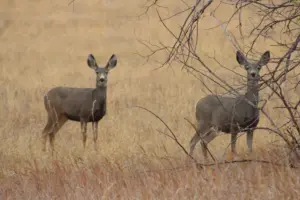
While moderate habitat remains in the traditional range of the state’s mule deer herd in the western third of North Dakota, most notably in areas of the badlands which can’t be developed or farmed and in those spaces which are protected as state or national grasslands and parks, the animals continue to struggle following significant mortality in the winter of 2022-23, and the decreased fawn production which came from the does that did survive the season.
“Mule deer numbers have been trending downward since 2021 in the badlands. We’ve been dealing with severe drought conditions, then that extreme winter in ‘22-23, and we’ve seen below average fawn production since 2021. And so those drought conditions that put those females in a poor nutritional state and then habitat conditions not as favorable for hiding and raising a fawn, we’ve seen those fawn ratios below average since 2021,” Stillings states.
Again, hunters likely found areas of hit-and-miss hunting, depending on habitat availability in their given area of access, with some seeing more muleys than others in those spaces that had good spring and summer regrowth of already-established cover on the landscape. That provides some reason for optimism for North Dakota’s mule deer heading into 2026.
“Now this past summer had good moisture for most of the western part of the state, most of the badlands; not the extreme southwest. That’s good for improving the forage conditions. And then this winter, we’re starting off what looks to be a mild to an average-type winter, hopefully that doesn’t change much in the next couple of months. Things are set up so that we could see better fawn production in 2026, and that could get that mule deer population moving in the right direction,” Stillings finishes.
Simonson is the lead writer and editor of Dakota Edge Outdoors.