


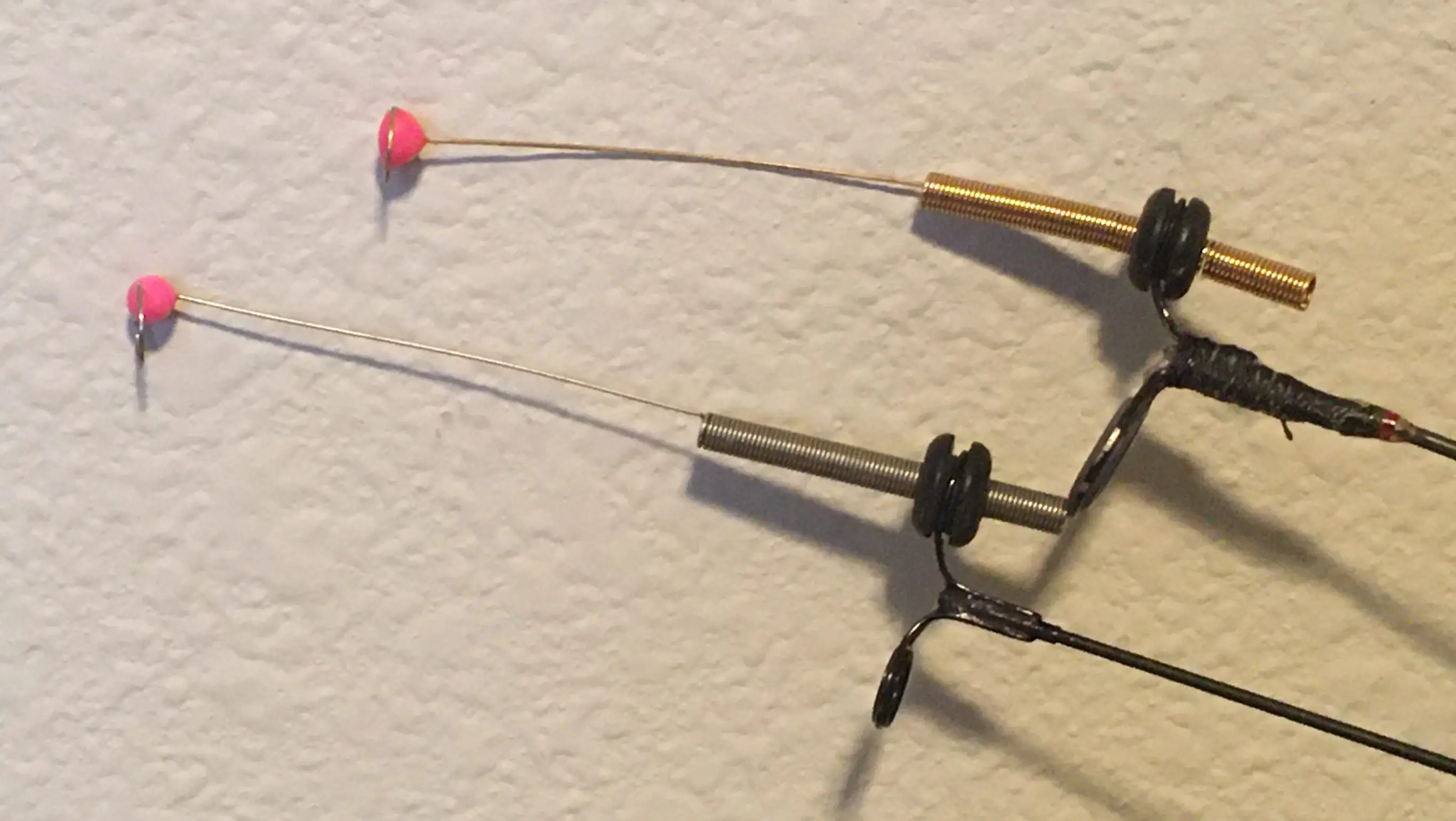
Spring bobbers of various sensitivities can help with presenting baits and detecting bites from finicky fish under the ice at midwinter or anytime. Simonson Photo.
By Nick Simonson
Midwinter is known for bringing on a bout of spring fever, but the focus on the season ahead of warming, melting and thawing isn’t necessarily what I have in mind. Rather, time on the ice still remains and good fishing can still be had with a bit of finesse and a combination of tools both old and new to help turn finicky fish into those rocketing up the hole with a few turns of the reel.
The spring bobber isn’t anything new. It’s likely been around for half a century as ice anglers adopted these super sensitive selections of wire that could be attached to the tip of an ice rod to detect the bites of fish like perch, crappies and bluegills – the latter of which are well known for an inhale and exhale of a bait that happens in a fraction of a second. Miss that moment where one of them samples your offering without actually eating it and you likely miss the opportunity to add to the pile (or start one) of fish on the ice or in your five gallon bucket.
Teamed with a dedicated panfishing rod and ultralight lines of one-pound or two-pound test, a spring bobber either bends slightly down or makes a quick jump up when a fish comes in and takes a small bait like a jig with a spike or waxworm on it. Here, coupling a sonar display with close monitoring of a modified rod tip with a spring bobber on it creates the ultimate tag team on hard water at this point in the season. Simply monitor the sonar for fish moving in and up to inspect your offering, and when they start to close in, switch your gaze to the spring bobber for a take. You can also gently squeeze, tap or pulse the rod to give the bait a jiggle and see how much the spring moves prior to the take, if fish are a bit more active or need a bit more enticement to rise. It’s best to work a pause into the presentation as the fish closes the distance, however, to see if they bite using the spring as an indicator.
The challenge I find in middle age, especially on recent outings, is shifting that gaze from the red-and-green display of my sonar to my rod and keeping everything in focus. Luckily all of my springs are adorned at their terminal eyelet with a dab of orange or chartreuse paint that makes detecting the jump in the accessory easier, and it requires no reading glasses to get things in focus. All I have to do is watch for a slight movement in the colorful end, then set the hook and it’s fish on, even in the doldrums of midwinter.
Now, as conditions are a bit harsher, weather systems and pressure whipsaws a tad more wicked, and fish a little more fussy under the ice as a result, a spring bobber can save the day – especially for perch, crappies and sunfish. Utilize a devoted panfish rod for these species, keep lines and baits light to match the sensitivity of the spring bobber and use both the modern technology of sonar along with the established option of a spring to get the most out of every trip and keep that other kind of spring fever at bay with increased catches on the ice…in our outdoors.