


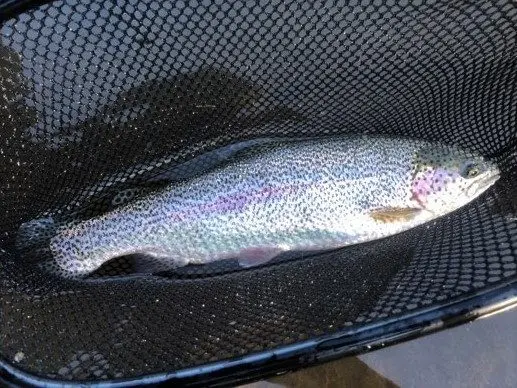
Nets both big and small make landing fish easier in all forms of angling, and they help handle those bigger specimens when barehanding can result in lost fish and a less-than-ideal outcome. Simonson Photo.
By Nick Simonson
The things you own end up owning you. It’s a statement I say every so often in life, as mechanical things break down, technology freezes up, and the piles of day-to-day stuff mount in the corner of the basement storage area, some requiring more work that I’d like to invest. I uttered it at least once this weekend as I broke down my ice fishing gear and got it ready for the offseason. While finishing up the process in the garage, however, I looked at the oversized net I had hanging on the wall and fondly recalled some great sturgeon fishing, and remembered just how glad I was to have it in my hands as my godson brought in a girthy 62-incher a couple of seasons back. I think I feel the same way about all nets in the moment, for any fish big or small, as the net is often the difference between owning the moment, or getting owned by it.
If you’ll pardon the double negative alliteration, I’ve never not needed a net for fishing. As I stared at the wall, I cycled through that purchase and all the models I currently own, which do very little owning back of my life, besides perhaps the inch-deep space they occupy on the wall or tucked against the gunwale of the boat. In fact, there’ve been times while fishing – simply out casting around town, targeting panfish, or just not thinking about it on the way out the door – where no net has been at hand and I sure could have used one. Whether it was the unexpected large northern pike on a night of walleye fishing, or a rogue trophy bucketmouth during a morning of spring fly fishing for crappies, not having a net often results in memorable and disappointing moments in the outdoors. That half dozen or so nets floating around above the clutter of my life certainly do more good than harm. Though my wife, who once took the handle of one to her cheek just below the eye, requiring stitches, may argue otherwise.
Even those basic models which still hang about, and the larger or more specialized ones I’ve devoted to my various watercraft and fishing styles, serve their purposes well and make grabbing them for a trip easier, providing peace of mind in the limited space I might have on a given adventure. Some like the trout nets I utilize while fly fishing, I’ve found creative methods to move and store, including magnets and carabiners that attach them to the back of my fishing vest or life jacket. Other more standard ones, I am simply able to compress, fold and extend, based on the model. Even at the lake cabin, when I make a run down the shore for a few sunset casts after the spring walleyes that stack up in front of the creek, I’ll grab the well-worn net from the dusty corner of the boathouse, and lay it in the nearby sand, just in case.
Whether it’s the large-basketed model for pike, muskies and sturgeon, the long-handled one which doubles for walleyes from both shore or over the raised edges of the boat, or the rubber meshed model that makes releasing fish and lures like spoons and crankbaits easier, those nets in my possession and scattered about among my watercraft, are all well worth the space they occupy and the minimum maintenance they all require. Of all the fishing things that end up as clutter in the corners of my garage – old rods, spools of line, foam blocks covered in flies and lures – nets do not fall into that category.
While I’m sure one can have too many nets, I don’t know if I’ve hit that threshold yet. Psychologically, I’m quite certain I never will, as it’s always a good feeling to know one is resting a short reach away when a big fish is on the line, or the process of landing any finned opponent will be made easier by a net, allowing me to take ownership of any angling scenario.
Simonson is the lead writer and editor of Dakota Edge Outdoors.