


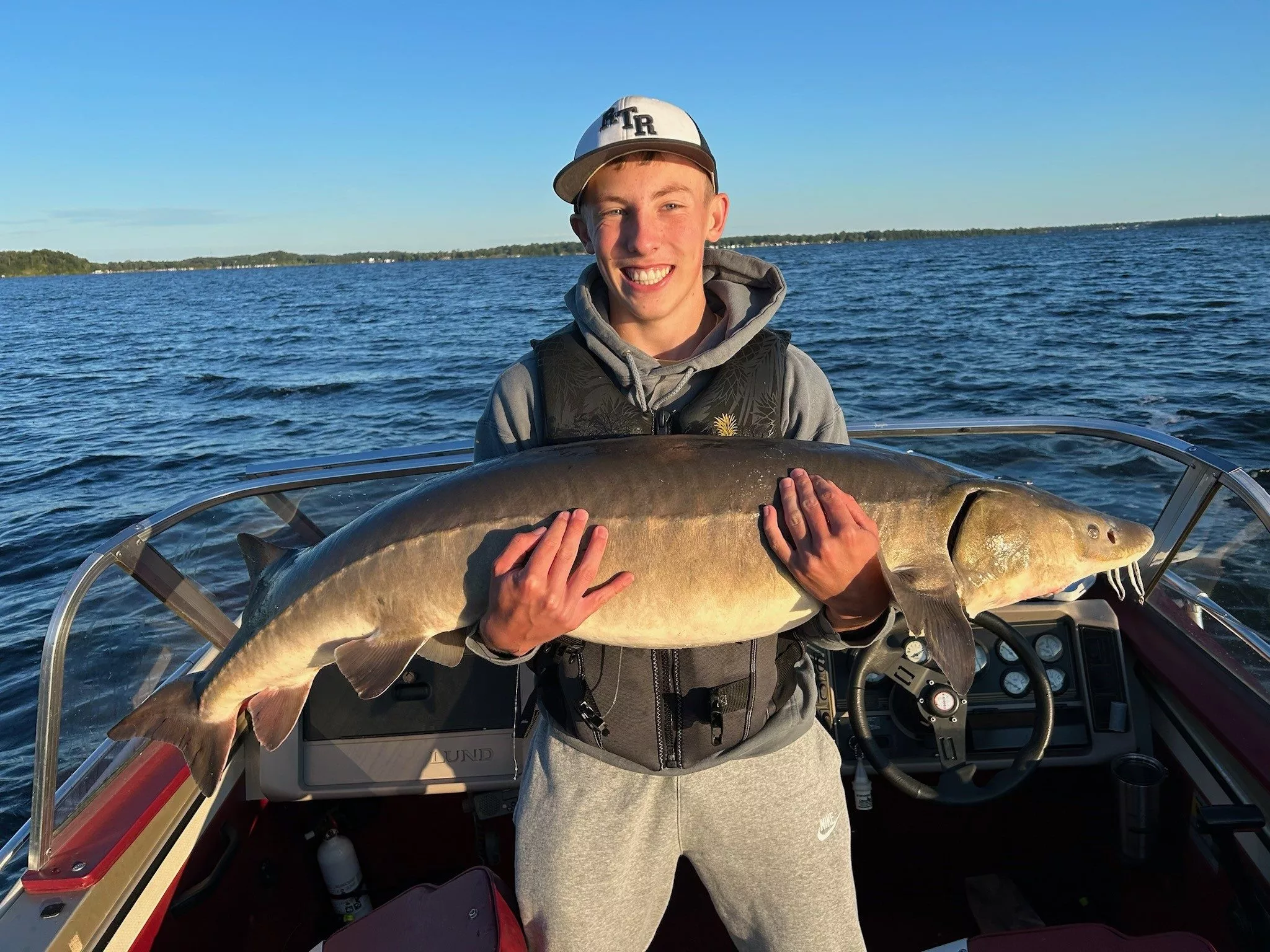
Anglers are encountering more sturgeon in sizes of 50 to 70 inches in those lakes and rivers on the eastern basin of the Red River drainage. Simonson Photo.
By Nick Simonson
Lake sturgeon continue to advance throughout the Red River and its tributaries, as the stocked populations of these once extirpated species from 23 years ago begin to repopulate the main stem and the lakes and tributaries upstream. In addition to an annual stocking program, rehabilitation of rivers and streams and the removal of lowhead dams which prevented sturgeon from reaching their native spawning grounds has now opened up suitable spawn sites and provided hundreds, if not thousands of added river miles suitable for the lake sturgeon’s continued recovery, according to Nick Kludt, Minnesota Department of Natural Resources (DNR) Red River Fisheries Specialist.
“Dam removal and modification is a huge part of this species’ recovery, because they lost access to a lot of their ancestral spawning grounds, that was one of their principal causes of decline. So our restoration sites kind of mimic those historic rapids in the river, and lo and behold, most of the spawning activity that was observed this spring was at those spawning sites at lake outlets,” Kludt details of what DNR staff witnessed in their 2025 sturgeon surveys over the past month.
DNR agents have observed sturgeon making spawning runs in stretches of the Ottertail River watershed over the past several springs, and are hopeful that in the near future those efforts and subsequent seasons will bring about young fish showing up in the agency’s surveys evidencing successful reproduction in the wild. It generally takes a female lake sturgeon 20 to 25 years to become sexually mature, while males take about 15 to 20. Females spawn every three or four years, while males typically spawn every one or two years. Lake sturgeon can live up to 100 years and reach lengths of over 80 inches.
Requiring areas of gravel and cobble for ideal spawning substrate, lake sturgeon will travel dozens or even hundreds of river miles to reach those locations best suited for reproduction in a flow. Through lowhead dam removal and conversion to rock arch rapids and other replacements that can be navigated by these powerful fish, the DNR has partnered with federal, state and tribal groups and agencies to open more and more river miles each year. This summer, in partnership with the Minnesota Department of Transportation (DOT), agents will be working to open more of the Ottertail River in western Minnesota to continue expanding areas for lake sturgeon.
“We are working to continue our fish passage program in the Ottertail River. We recently modified four major lake outlet dams, that was principally within the Ottertail-Rush-Big Pine area and we’ve seen really good success there. We’re now trying to press that fish passage further upstream to get those fish further into the headwaters, because there’s really excellent spawning habitat up there,” Kludt details, adding, “that partnership is actually with Minnesota DOT. We are working with them using two different federal funding sources to modify a major road crossing where U. S. Highway 10 intersects with the Ottertail River and we’ll be going from a pair of culverts to span bridges there, which will open up the river, daylight it, and allow all those species to make their seasonal movements unimpeded, regardless of flow.”
The recovery has gone so well that a catch-and-release season for lake sturgeon is open in those waters of west-central Minnesota’s lakes country. Currently that catch-and-release season begins on June 16 of each year and closes on April 14 of each year. During that time anglers can actively target the fish in those waters, but must release them after the catch. Good populations in lakes along the Ottertail River, Pelican River and in the Red River exist for anglers to tangle with and fish eclipsing the 70-inch mark have been observed in those lakes and flows upstream from the Red River.
“Average size, you’re going to see a lot of males in that high 40 up into the high 50 [inch] range, the females are also going to be in that 50 to 60 range, a little bit heavier a little bit more round if you’re looking at females that haven’t spawned this spring. As far as the big ones in the river right now, right around 75 inches is a really nice fish for the Ottertail or the Pelican River system,” Kludt advises.
Anglers can utilize a stout rod and baitcasting reel with a strong drag mechanism, braided line of 50 to 80 pound-test, and circle hook rigs on a flat teardrop weight of one to two ounces in lakes, or bump up to three to five ounces in a river if the flow is high and fast. The most popular bait option consists of balls of three or four nightcrawlers on circle hooks in sizes of 3/0 to 5/0. More information on the lake sturgeon’s recovery and their biology can be found at: https://www.dnr.state.mn.us/minnaqua/speciesprofile/lake_sturgeon.html