


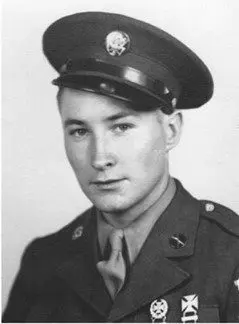
FORT RANSOM, N.D. (NewsDakota.com) – In today’s political debates, Americans are once again hearing a phrase that emerged from the aftermath of World War II: soldiers must refuse unlawful orders. The idea is sometimes controversial, but the principle itself is deeply rooted in military law and American tradition.
More than eighty years ago, a young soldier from Fort Ransom, North Dakota quietly demonstrated exactly what that principle looks like. His name was Peter B. Granlund. Born in 1925 and raised in the Norwegian Lutheran community around Fort Ransom, Granlund grew up in the kind of rural environment that valued humility, responsibility, and respect for others. Granlund grew up in the Norwegian Lutheran community around Fort Ransom and graduated from Fort Ransom High School in 1943 before entering the United States Army during World War II. Granlund became an infantry sergeant in the European theater, fighting in some of the most difficult campaigns of the war. His unit saw action in the Hürtgen Forest, endured the brutal winter of the Battle of the Bulge, and later advanced into Germany as Allied forces pushed toward victory. These were among the harshest conditions of the war, bitter cold, constant danger, and exhaustion that pushed soldiers to their limits.
At one point during that campaign, Granlund found himself responsible for several German soldiers who had surrendered to his unit. According to an account later documented by legal scholar Dakota S. Rudesill, Granlund’s
lieutenant ordered him to execute the prisoners. The order violated the laws of war. Under the established rules governing armed conflict, surrendering soldiers are considered prisoners of war and must be protected. These protections had already been recognized internationally under the 1929 Geneva Convention governing the treatment of prisoners of war, which prohibited the killing of captured soldiers who had laid down their arms. Granlund faced a choice. He was nineteen years old. He was in combat. And the order came from a superior officer. He refused.
According to the documented account, Granlund rejected the order and refused to carry it out. His decision had an immediate effect. The lieutenant backed down, and the soldiers under Granlund’s command followed their sergeant instead of executing the prisoners. Because of that refusal, no unlawful killing occurred. Granlund survived the war and returned to civilian life. Like many veterans of that generation, he built a life centered on service to others. After earning a degree from Valley City State University, he became a public school teacher. Former students later remembered him as thoughtful, calm, and deeply interested in helping young people think about the world around them. He eventually settled in Port Angeles, Washington, where he lived for many years before his death in 2022 at the age of 96.
Granlund’s story is not widely known outside legal or historical circles. Yet it carries a powerful lesson.
In the aftermath of World War II, the Nuremberg Trials established that “following orders” does not excuse unlawful actions. That principle became central to modern military law and ethics. American service members today continue to receive training based on that same understanding: follow lawful orders, refuse unlawful ones. Doing that in theory is easy. Doing it in combat takes courage.
For communities like Fort Ransom, stories like Granlund’s remind us that the values taught in small rural towns can echo far beyond their borders. Character, humility, and respect for the law are not abstract ideas. They are habits formed in families, churches, and schools.
More than eighty years ago, when that moment came, a young sergeant who had grown up in the small classrooms of Fort Ransom quietly did what he believed was right. He didn’t make a speech about it. He simply refused an unlawful order. That quiet courage still speaks today.
Author Bio
Dr. Steven L. Johnson is superintendent of the Fort Ransom School District and a member of the Executive Committee of the National Rural Education Association. He served as superintendent of Lisbon Public Schools for 28 years and has spent nearly five decades working in rural education. A fourth-generation North Dakotan, he continues to ranch with his family while advocating for rural schools and communities.