


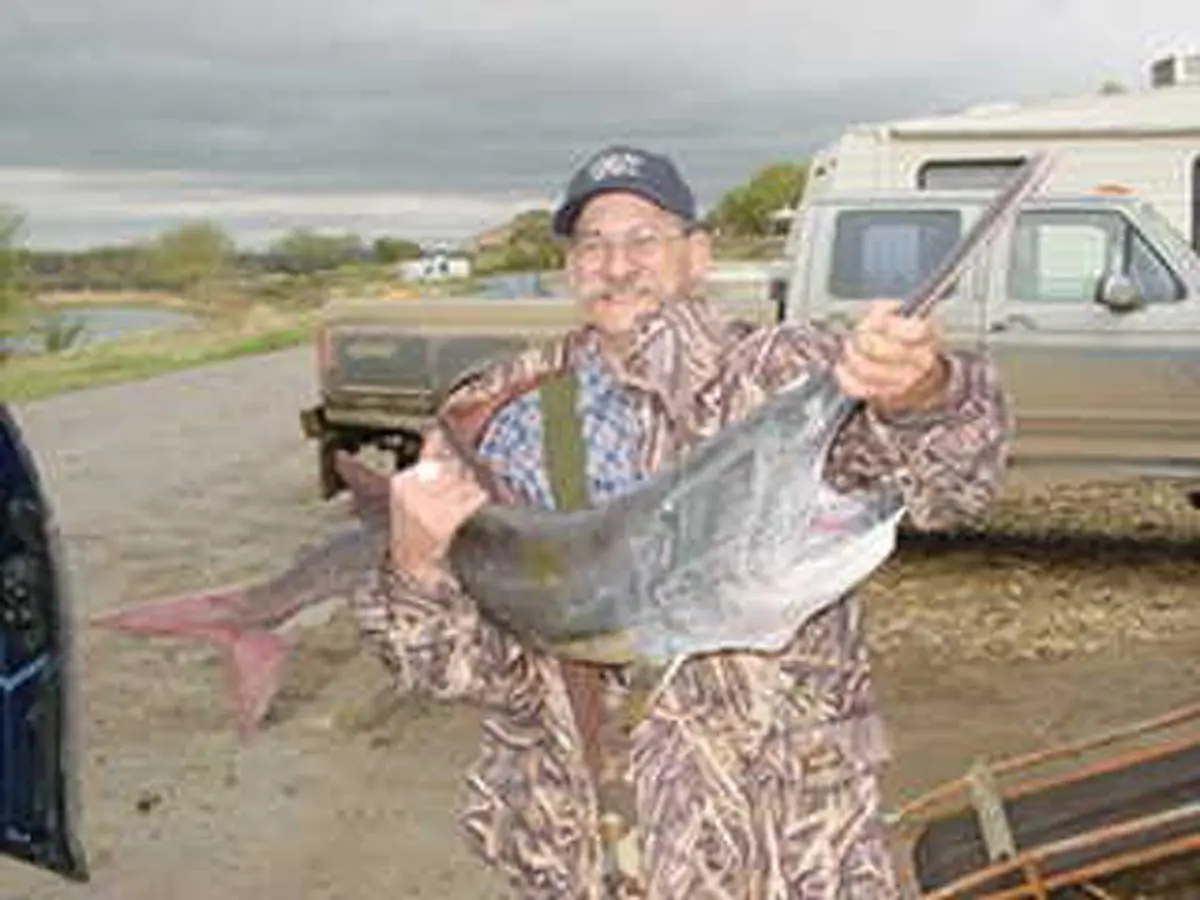
Anglers congregate at the confluence of the Missouri and Yellowstone Rivers in western North Dakota each spring beginning May 1 in the hopes of snagging a large paddlefish. Photo Submitted.
By Nick Simonson
At the confluence of the Missouri and Yellowstone Rivers at the start of May, you’ll find a cadre of anglers looking to connect with one of those waters’ most ancient and unique species of fish. However, it isn’t the normal angling tactics that pay off when targeting paddlefish in North Dakota, as the filter feeders with the flat, elongated spatula-like snout that gives them their name typically can only be snagged through the process of casting heavy weights, large treble hooks, and ripping those setups back through the muddy spring waters to shore, according to Jeff Merchant, Fisheries Biologist for the North Dakota Game & Fish Department (NDG&F).
“They are a very unique fish. They’re very long lived; we’ve aged paddlefish over 60 years. They spawn in late spring to early summer, and they’re on that spawning run right now and that’s when we have the season for them,” Merchant explains of paddlefish, generally.
Male paddlefish are typically smaller, in the 20-to-40-pound range for the most part, while females can eclipse 100 pounds, with the North Dakota state record slot shared by two 131-pound fish caught in 2016 and 2024.
Following the damming of Lake Sakakawea, paddlefish became well established in the Missouri River and Yellowstone River upstream from the large reservoir, as flooded areas produced strong populations of zooplankton, the species’ primary food source which they obtain by swimming mouth-open through the water and filtering the small lifeforms out via specialized structures on their gills. It’s a bit of a journey to their desired spawning areas, where mature paddlefish will lay and fertilize eggs, and the young will hatch and go downstream with the current.
“They’re looking for flooded gravel bars in the lower Yellowstone River and also up in the Missouri River system to lay their eggs. After the eggs hatch the larval fish drift downstream to the headwaters area of Sakakawea as it’s where zooplankton is most abundant,” Merchant explains of the seasonal biology driving the season, and ultimately the numbers of paddlefish in the flow, adding, “the population is pretty stable. After the Garrison Dam was built, the paddlefish population had a boom with all the productivity in the reservoir and since then it’s been on the decline. But they are a long-lived species and the population tends to be driven by really good year classes, and those year classes don’t have to occur that often. The current population is really driven by a tremendous year class in 1995,” Merchant concludes.
The North Dakota paddlefish snagging season begins on May 1 and runs through May 21, unless the state quota for harvest is met earlier than the scheduled close. The activity requires a special tag to be in possession of a licensed angler. The tag can be purchased at any NDG&F district office, or online at gf.nd.gov and mailed to the angler, however the angler must have the tag in his or her possession prior to snagging and should account for delays in mailing when ordering one via the website. Anglers should also be prepared for the physical effort that goes into snagging paddlefish, as Merchant relates that it can be challenging.
“It’s a pretty physical activity, I’ve done it myself. You can spend a lot of time up there, casting and reeling, casting and then jerking that rod, and it’s a heavy rod, it takes a lot out of you. I know some groups will have just one rod and they’ll take turns casting it. Generally, to bring them in once you get them hooked, the smaller ones you have to stay on them and reel them in. Some of the bigger ones you almost have to let go in the current and keep pressure on them and eventually they drift to shore downstream a little ways,” Merchant states of the work involved in paddlefish snagging.
Fishing hours run from 7am to 7pm during each day of the paddlefish snagging season with Sundays, Mondays and Thursdays reserved as snag-and-release only days according to Merchant. If a quota is met in a season, the NDG&F will issue an announcement and the season will remain open for a few more days to snag-and-release only fishing, but in no instance later than the season’s closure date of May 21. More information on paddlefish snagging, including designated areas of the Missouri River and Yellowstone River open to the activity, can be found at gf.nd.gov/fishing/paddlefish-snagging.
Simonson is the lead writer and editor of Dakota Edge Outdoors.